
- Share
- Share on Facebook
- Share on LinkedIn
The molecular foundations of bacterial growth remain little understood today, because they involve large biochemical networks with physical and regulatory interactions across different levels of cellular organization. We combine models and experiments to understand how changes in microbial growth are linked to gene expression and metabolic network dynamics.
Post-transcriptional regulations in E. coli
Stéphan Lacour, Delphine Ropers
Dynamic transcriptomic data open up the possibility of understanding, at the whole-cell level, the mechanisms that control the stability of messenger RNAs. We combine large datasets with simple models of mRNA degradation to propose hypotheses regarding the nature of the post-transcriptional regulatory mechanisms involved in the adaptation of gene expression to environmental changes.
Inference and analysis of cellular metabolism
Hidde de Jong, Delphine Ropers
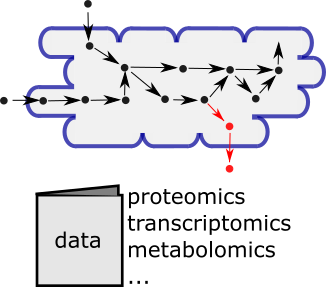
Modelling bacterial metabolism using models based on genome-wide metabolic reconstructions enables us to establish a link between phenotype and genotype. We incorporate experimental data into these models in the form of constraints in order to analyse metabolic activity during bacterial growth in different environmental and genetic contexts. While reconstructions are available for well-studied organisms such as E. coli, this is not the case for lesser known species. In such cases, we either reconstruct metabolic networks from genome sequences or infer metabolic functions from metabarcoding data.
- Share
- Share on Facebook
- Share on LinkedIn