
- Share
- Share on Facebook
- Share on LinkedIn
Publication / Research
On March 6, 2026
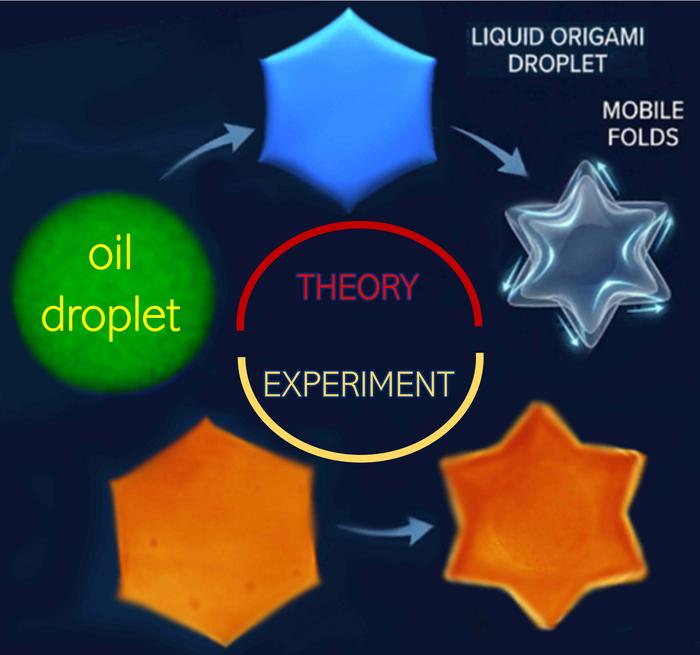
Liquids are supposed to flow, not fold. Yet microscopic oil droplets can reliably morph into lenticular hexagrams ( six-pointed stars) while staying liquid inside.
This striking behavior arises because the droplet surface freezes into a thin crystalline nano-shell that bends like a tiny hexagonal pita (a pocket-like flatbread), adopting a six-pointed star profile upon inflation of its interior, or shinking of its surface. Unlike conventional origami, where folding occurs along fixed crease lines, the folds of the inflating hexapita are mobile : they slide across the interface as the droplet deforms, continuously reshaping the star. The resulting hexagram, a symbol shared across cultures, emerges from the interplay of interfacial thermodynamics, geometry, topology, and elasticity. By revealing this nanoscale, mobile-fold origami mechanism, the work opens new routes for designing complex-shaped colloids and nanoparticles. It suggests that similar folding principles may operate in biological systems, playing role in morphogenesis of complex organisms, such as six-pointed star-like bacteria, and beyond.
For more information, have a look at:
- the scientific article in Physical Review Letters,
- the science outreach articles published in Physics Magazine, Chemical & Engineering News, Phys.org, EurekAlert!, Scienmag, Bioengineer.org, The Silicon Review & Life Technology.
Date
Contact
Catherine QUILLIET
catherine.quilliet univ-grenoble-alpes.fr (catherine[dot]quilliet[at]univ-grenoble-alpes[dot]fr)
Reference
C. Quilliet, A. V. Butenko and E. Sloutskin. Lenticular Hexagon-to-Hexagram Shape Transformation: Nano-Origami in Liquid Droplets. Physical Review Letters 136(8), 084002 (2026)
- Share
- Share on Facebook
- Share on LinkedIn