
- Share
- Share on Facebook
- Share on LinkedIn
Recruitment
Offer description
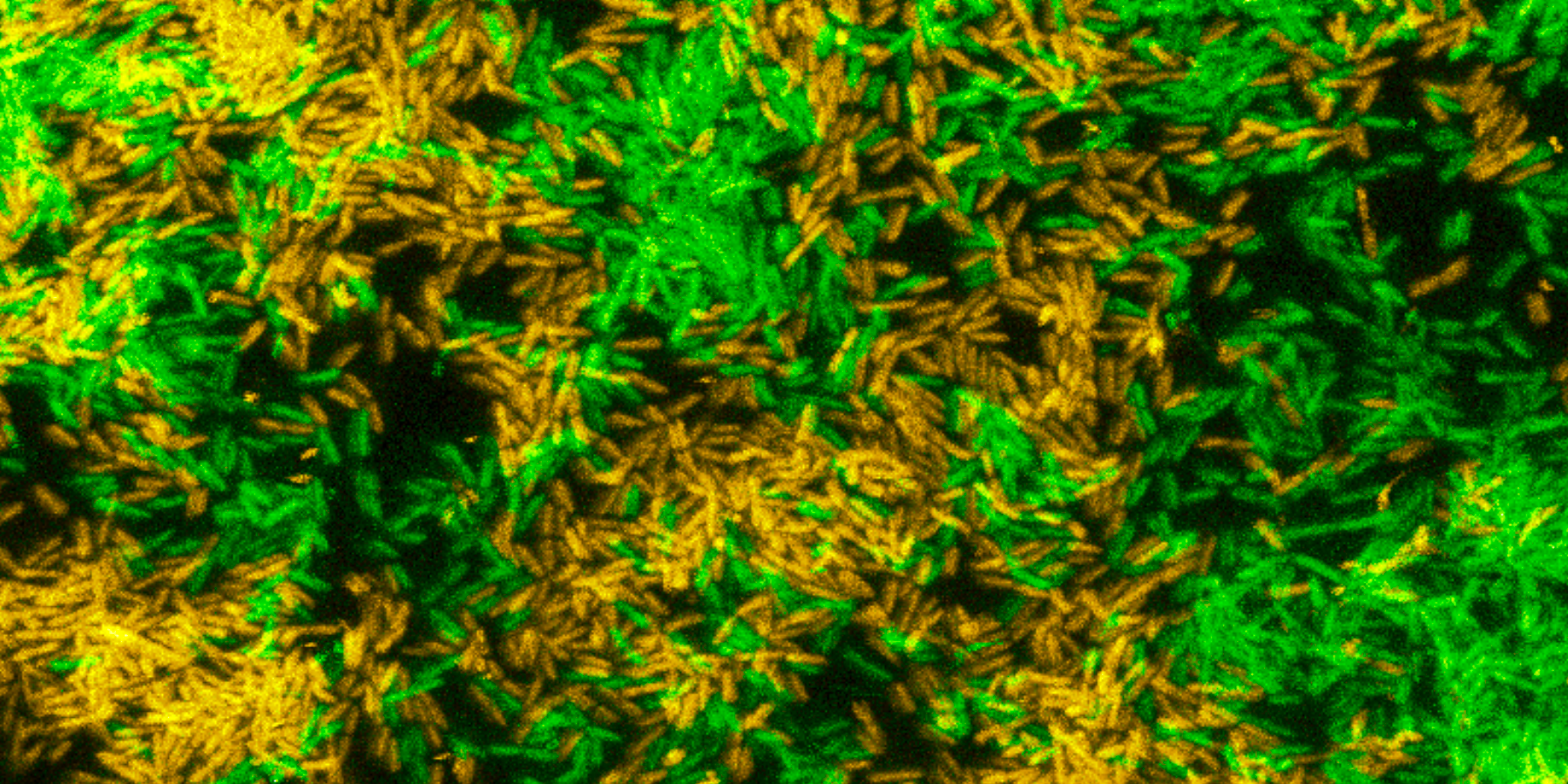
The spread of pathogenic micro-organisms from the surface of contaminated equipment represents a major public health issue, causing nosocomial infections or food spoilage. Surface contamination by bacteria involves the secretion of an extracellular matrix that greatly increases resistance to chemical, pharmaceutical or mechanical assaults. However, this matrix production and subsequent firm adhesion to the surface also limits the ability of bacteria to explore widely their environment, providing a fitness advantage to species with more transient surface interactions. The competition and cooperation between different strains or species is thus highly dependent on their surface exploration strategy, but also on external physical stresses that can be encountered either continuously under flow or as catastrophic events such as surface dewetting.
This PhD project aims to investigate experimentally how dewetting-mediated surface decontamination can influence the balance between different bacteria competing for surface colonization, and how co-operative effects can arise through the sharing of secreted matrix components.
The successful candidate will combine the experimental know-how of the involved teams in microbiology, microfluidics, microscopy and image analysis to study the role of motility and extracellular matrix in bacterial competition for the contamination of surfaces, and how this competition is affected by catastrophic events such as surface dewetting. They will design and perform model experiments to image bacterial adhesion, colony formation, and subsequent removal or reorganisation of bacteria under the passage of a bubble in a flow channel. In a second part, they will also investigate whether sub-populations of bacteria with particular phenotypes are selected during bubble transit and drying, and whether this selection influences the ecological balance on the surface. Finally, they will interact with a team of soft matter physicists and theorists in an effort to model their experimental data.
Work environment
The project is a collaborative effort between the Physics lab at ENS Lyon (LPENSL) and the Lab for Interdisciplinary Physics (LIPhy) in Grenoble. The 2 cities are major research centers in France located about 1h away from each other near the French Alps. Both labs bring together theoretical and experimental researchers covering a broad range of expertise including soft matter physics, biophysics, fluid mechanics, physico-chemistry, biology and optics.
The successful applicant will work under the co-supervision of Dr. Delphine Débarre (Grenoble) and Dr. Sigolène Lecuyer (Lyon). They will divide their time equally between Lyon and Grenoble. Existing contacts with microbiologists are also in place to access clinical isolates. Finally, international collaborations (Spain, UK, Japan, Germany) will provide a diversity of interactions.
The project is fully funded for 3 years, and can be started between September 2026 and January 2027. The gross salary will be around 2300 €/month (with additional benefits for health coverage, transportation, child support, etc.).
Skills/qualifications
We are looking for an enthusiastic and rigorous experimental physicist, biophysicist or microbiologist with a keen interest in multidisciplinary work. Experimental work will include microfluidics, microscopy and microbiology. No previous experience in these fields is required but good experimental skills and a taste for meticulousness are essential. Interest for soft matter concepts and modelling will help to interpret the data. Experience in data analysis (including programming) is a plus.
The working language of the team is English: a good level is required, as well as good communication skills to ensure efficient collaboration between the labs. Good time management and planning skills are essential, with a proven ability to meet tight deadlines and to manage competing demands effectively, responsibly and without close support. You should be able to work well both independently and as part of a team, as demonstrated by previous experience.
In addition, the position is in a sector related to the protection of scientific and technical potential (PPST) and therefore requires, in accordance with regulations, that your arrival be authorized by the competent authority of the French Ministry of Higher Education and Research (MESR).
Constraints and risks
The bacterial model system is the opportunistic pathogen P. Aeruginosa which can cause health problem to immunocompromised people or in case of pregnancy. In such cases adjustments will be discussed to mitigate the risk. In all cases appropriate health & safety training will be provided.
Contact
Delphine Débarre
MC2 team
delphine.debarre univ-grenoble-alpes.fr (delphine[dot]debarre[at]univ-grenoble-alpes[dot]fr)
How to apply
Full offer on Portail Emploi CNRS.
- Share
- Share on Facebook
- Share on LinkedIn