
- Share
- Share on Facebook
- Share on LinkedIn
Séminaire
On September 18, 2026
Pablo GRISANTI - (PhD, PSM) || Subhadeep DASGUPTA - (Post-Doc, PSM)
CO₂ diffusion in CALF-20: From small to not-so-small scale.

Pablo GRISANTI - (PhD, PSM)
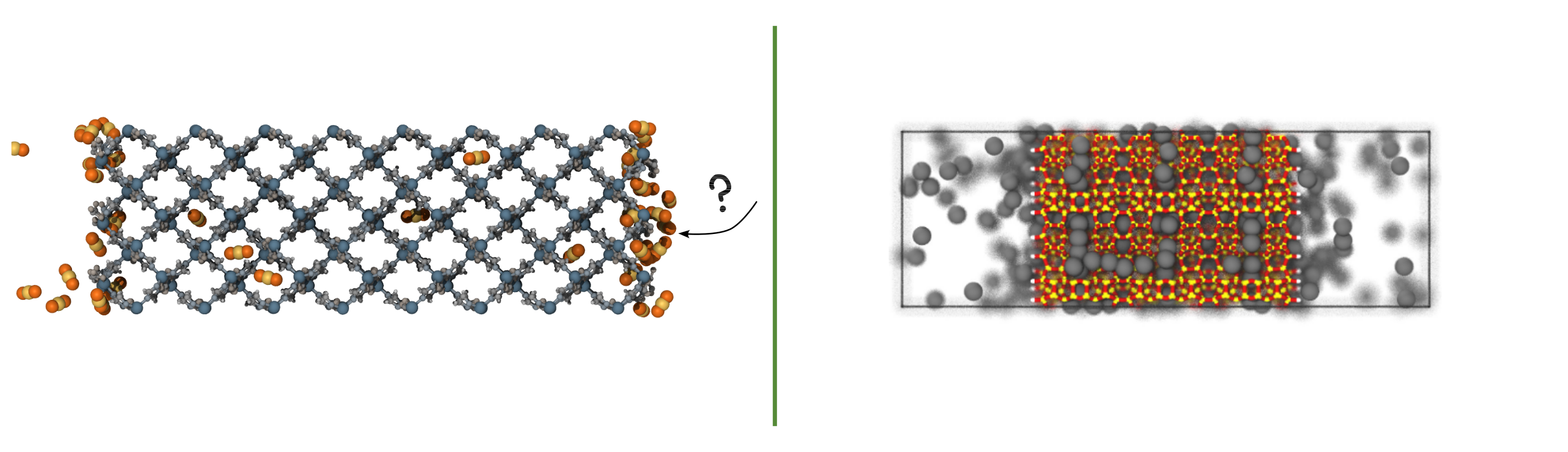
Environmental concerns have driven growing interest in CO₂ capture and storage technologies. Nanoporous materials offer a promising solution in this field, particularly Metal-Organic Frameworks (MOFs), owing to their structural versatility and tunable properties. However, under realistic conditions these materials must operate in the presence of water, which can be detrimental to the adsorption process. In this work, Molecular Dynamics (MD) simulations are employed to study bulk CO₂ diffusion and how it is affected by the presence of water. The study focuses on CALF-20, a prototypical MOF with sub-nanometer cages and great potential for CO₂ capture applications. Furthermore, uptake simulations in a CALF-20 slab are performed and compared with a numerical grid model that enables fast diffusion calculations of CO₂ at micrometer scale.
Intermittent Brownian Motion of Fluid Transport in Nanoporous Materials and its Surface Resistance: Using Molecular Simulations.

Subhadeep DASGUPTA- (Post-Doc, PSM)
Nanoporous solids, like metal-organic frameworks and zeolites, are promising candidates for fluid transport mechanisms, in complex separation processes. The entry-exit of penetrants across surface boundaries is still not a well studied dynamical process, and our understanding is only at a nascent stage. Using molecular simulations (grand canonical Monte Carlo, and all-atom molecular dynamics) of CO2 in zeolite (MFI-type silica) we study the intermittency of gases diffusing across the host solid surface. In this work, we will present how the effective surface experienced by fluids may grow both inwards or outwards from the geometrical edge. We study the relations between gas diffusivity, width of the interface, and the fractional occupancy by considering the zeolite to be in series or parallel to the dynamics. The intermittency at the surface motivates us to study surface residence and relocation times, and then proceed to understand their statistics based on physical laws. We quantify the intermittency based on survival probabilities, rate of transition, and compare the analytical spectral density against computationally obtained results
Date
13:30
Localisation
LIPhy, salle de conférence
- Share
- Share on Facebook
- Share on LinkedIn