
- Share
- Share on Facebook
- Share on LinkedIn
Thesis defence
On December 15, 2026
Julien Allègre
The scope of this PhD work is the mechanical and electrical study of a liquid electrolyte confined by metal surfaces. Liquid electrolytes play a central role in energy storage and conversion technologies such as batteries, supercapacitors, and osmotic energy harvesting. To improve the performance of these applications, it is necessary to understand the fundamental physics of electrolytes under nanoconfinement, particularly within electrodes or nanoporous membranes. Indeed, it is the electrolyte-solid interfaces that govern the performance of these applications through transport processes and their surface interactions. Beyond these applications, these interfaces raise fundamental questions that remain unanswered regarding the structure and dynamics of the electric double layer, as well as its role in the generation of hydrodynamic, electric, or ionic flows driven by pressure, potential, or concentration gradients (electrokinetic couplings).
The tool of choice for simultaneously measuring equilibrium interaction forces and the dynamic responses of a liquid in a model confinement is the dynamic surface force apparatus (dSFA). Recent work with this instrument within the team has revealed overdamping relative to Reynolds viscous damping in dielectric confinement, attributed to electrokinetic couplings. However, the glass surfaces used until now did not allow for control of the electrical boundary condition at the interfaces.At the same time, electrochemical techniques enable the control of the electrical boundary conditions at the electrodes in electrochemical cells. However, the often complex and heterogeneous geometry of these electrodes leads to cumbersome equivalent electrical circuits, the physical interpretation of which is most of the time challenging.
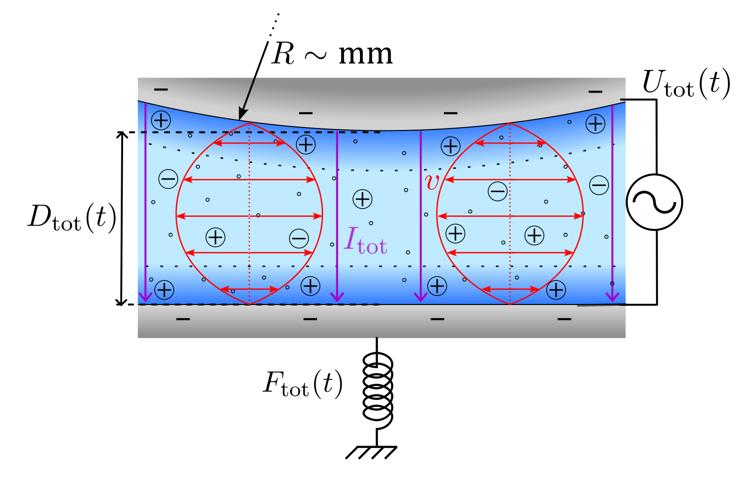
To overcome these two limitations, this study proposes combining mechanical and electrical measurements on an electrolyte confined by metal surfaces within a dSFA. This approach enables: (i) leveraging the model geometry of the dSFA, (ii) controlling the electrical boundary conditions of the confining surfaces, and (iii) combining mechanical and electrical measurements (equilibrium and transport) of a confined electrolyte.First, we present the instrumental development that enables the metallization of the dSFA’s confining surfaces in order to control their electrical properties. Next, we study the effect of metallic confinement on the dynamic mechanical response and show that it profoundly alters the damping compared to dielectric confinement. Finally, we report on the implementation and modeling of electrochemical impedance spectroscopy measurements, which provide insight into electrical transport within the controlled geometry of the dSFA.This PhD thesis paves the way for a joint study of mechanical and electrical responses and electromechanical couplings in confined electrolytes.
Date
14:00
Localisation
LIPhy, conference room
- Share
- Share on Facebook
- Share on LinkedIn