
- Share
- Share on Facebook
- Share on LinkedIn
Recruitment
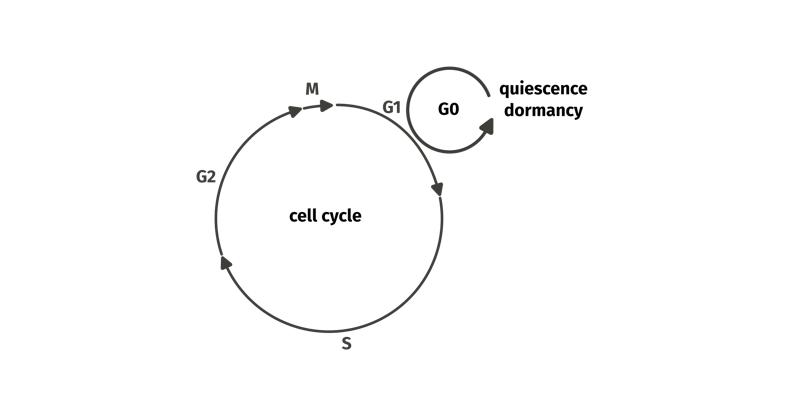
Cells can dynamically switch between proliferative and quiescent states, with significant implications for the physiology of multicellular organisms. This flexibility allows developing embryos to pause when subjected to stress and cancer tumors to escape drug treatment [1].
Quiescence is particularly difficult to explore and characterize, as it is a transient, reversible state that can be induced by many external factors, including thermal stress. Since little is known about how a temperature perturbation can affect the metabolism of human cells beyond the heat-shock response, we propose to explore how this existing switch between quiescence and proliferation is modified by thermal stress.
The purpose of the internship is to characterize the distribution of quiescent states in a live cell population in response to a temperature perturbation [2,3]. The student will need to perform cell culture and live microscopy, followed by image analysis.
A background in cell culture is a plus, but not an absolute requirement. A training background in biology or experimental physics is welcome. The internship should last at least 4 months, and can be followed by a thesis.
[1] Daniela Senft and A Ronai Ze’ev. Adaptive stress responses during tumor metastasis and dormancy. Trends in cancer, 2(8):429–442, 2016.
[2] Sabrina L Spencer, Steven D Cappell, Feng-Chiao Tsai, K Wesley Overton, Clifford L Wang, and Tobias Meyer. The proliferation-quiescence decision is controlled by a bifurcation in cdk2 activity at mitotic exit. Cell, 155(2):369–383, 2013.
[3] Ana Rita Araujo, Lendert Gelens, Rahuman SM Sheriff, and Silvia DM Santos. Positive feedback keeps duration of mitosis temporally insulated from upstream cell-cycle events. Molecular cell, 64(2):362– 375, 2016
Contact
Manon VALET
MC2 team
manon.valet univ-grenoble-alpes.fr (manon[dot]valet[at]univ-grenoble-alpes[dot]fr)
- Share
- Share on Facebook
- Share on LinkedIn