
- Share
- Share on Facebook
- Share on X
- Share on LinkedIn
Seminar
On March 2, 2026
Matteo Milani (ESPCI Paris)
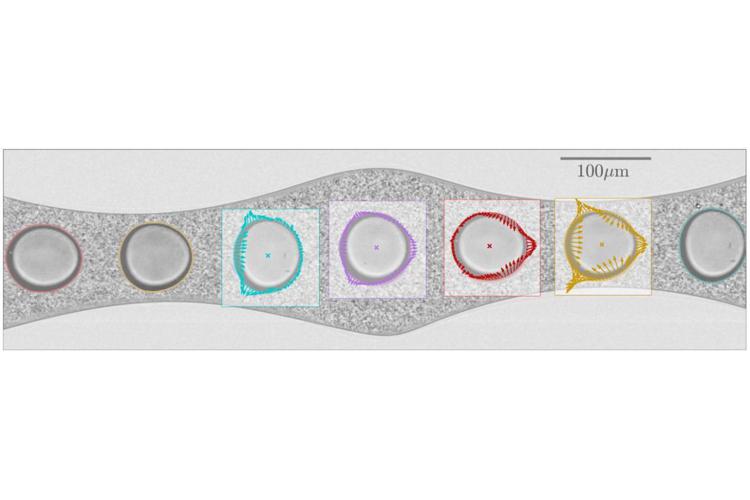
The measurement of frequency-dependent viscoelastic moduli is of paramount importance in many fields, from material science to biology, and is typically accomplished in bulk materials using commercial rheometers. The trend towards miniaturization in the biotechnology, manufacturing and chemical processing industries has motivated the extension of viscoelastic measurements to microscopic objects with well-defined shape and size such as droplets, vesicles, microcapsules, or even single cells. For instance, local mechanical probes such as AFM nanoindentation can be used to probe single-cell stiffness, and micropipette aspiration probes the interfacial properties of droplets and vesicles [1,2]. Despite their versatility, these techniques are characterized by complex deformation geometries and a relatively low throughput, which makes them unfit to sample highly heterogeneous populations such as those typical of biological samples. To this end, novel microfluidic approaches have been recently developed to measure the stiffness of cells and droplets flowing through narrow channels. These approaches are well-suited for applications requiring a high throughput, but they lack the fine control of stress and strain required by quantitative mechanical measurements. Here, we present a novel technique called Rheofluidics, which combines the high throughput of microfluidics with the versatility of traditional rheological probes. Like a stress-controlled rheometer, Rheofluidics measures the time-dependent deformation of droplets subject to a well-defined hydrodynamic stress, whose time evolution is controlled by the shape of the microfluidic channel in which the droplets are flowing. To validate this approach and to demonstrate the power of this technique, we study the linear and nonlinear rheology of oil droplets, hydrogel beads and lipid vesicles, extracting their viscoelastic properties with a throughput more than 1000 times higher than that of standard rheology.
[1] Costa, Kevin D. "Single‐cell elastography: probing for disease with the atomic force microscope." Disease markers 19.2-3 (2004): 139-154.
[2] Hochmuth, Robert M. "Micropipette aspiration of living cells." Journal of biomechanics 33.1(2000): 15-22.
Contact: Gwennou Coupier
Date
11:00
Localisation
LIPhy, salle de conférence
- Share
- Share on Facebook
- Share on X
- Share on LinkedIn