
- Imprimer
- Partager
- Partager sur Facebook
- Partager sur LinkedIn
Séminaire
Le 16 février 2026
Roxane Lestini and Nicolas Olivier (Laboratoire d'Optique et Biosciences, Palaiseau)
Archaea provide a simplified yet highly informative model for deciphering the complex regulatory networks governing DNA replication and origin firing. Among them, Haloferax volcanii has a circular chromosome with four active replication origins distributed across a 3.5 Mb DNA molecule and exhibit some distinctive properties, such as a heterogeneous polyploidy, carrying 10–18 copies of its genome.
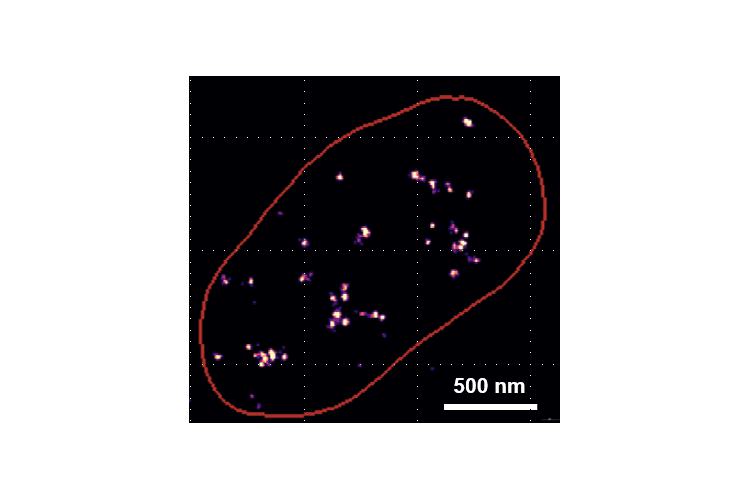
How these highly polyploid organisms regulate the activation and timing of their multiple replication origins in coordination with cell growth and division remains an open question. To address this question, we developed a multiscale approach, implementing the STORM technique in archaea for the first time, Marker Frequency Analysis by sequencing (MFA-seq) to capture the global replication profile at the population level, and fluorescence in situ hybridization (FISH) to explore ploidy variation.
Our findings reveal, with an unprecedented resolution of ~30 nm, new insights into the spatial regulation of replication foci, demonstrating their organization into clusters. We further investigated DNA replication dynamics under varying growth conditions, revealing a reduction in replication foci number that correlates with decreased replication rates and DNA content. By contrast, altering the replication initiation mode—by inactivating all four replication origins—does not disrupt the overall replication dynamics.
By integrating these techniques, we aim to characterize the replication program in H. volcanii and gain a deeper understanding of its regulation.
Contact: Delphine Débarre
Date
11:00
Localisation
LIPhy, salle de conférence
- Imprimer
- Partager
- Partager sur Facebook
- Partager sur LinkedIn