
- Imprimer
- Partager
- Partager sur Facebook
- Partager sur LinkedIn
Séminaire
Le 7 décembre 2026
Solène Pérot (Université Libre de Bruxelles, Belgium)
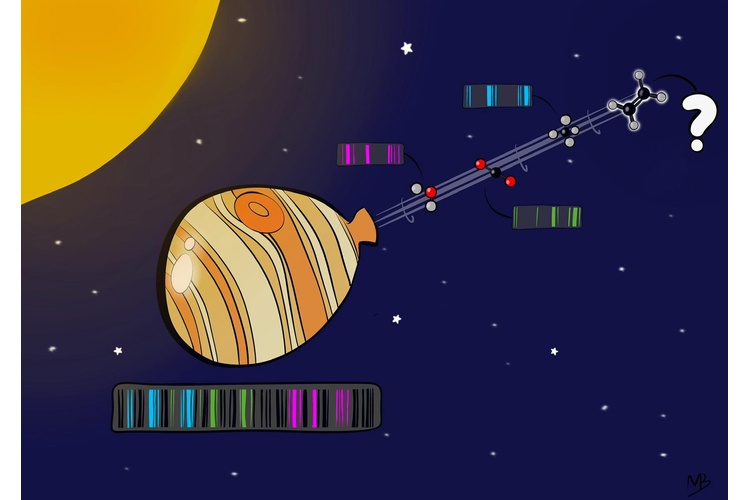
Studying the composition of (exo)planetary atmospheres provides key information to understand planet formation and evolution, and sheds light on the processes leading to complex organic molecules. Observations from ground- and space-based telescopes are available to detect molecular species. However, the interpretation of such observations relies on the availability of reference spectroscopic data for relevant molecules under the right conditions.
In this talk, I will present my work in high-resolution infrared spectroscopy to record molecular fingerprints necessary for detection in planetary atmospheres. During my PhD, I studied ethylene (C2H4) at temperatures relevant to the hot Jupiter exoplanets. To do so, jet-cooled ethylene spectra were recorded around 1.6 µm using cavity ringdown spectroscopy and modelled to identify rotationally cold transitions belonging to both hot and cold bands. My post-doctoral work focuses on the spectrum of allene (propadiene, C3H4) at room temperature. Fourier-transform spectra were recorded around 11 µm using a Bruker IFS 120 to 125 HR upgrade spectrometer. Line positions were analyzed using an in-house effective Hamiltonian code and line intensities were measured by multi-spectrum fitting. The spectroscopic data obtained will be used to quantify allene in Titan’s atmosphere.
Contact: Yann Le Coq
Date
11:00
Localisation
LIPhy, salle de conférence
- Imprimer
- Partager
- Partager sur Facebook
- Partager sur LinkedIn