
- Share
- Share on Facebook
- Share on LinkedIn
Recruitment
M2 internship
Supervisors: Samantha Micciulla and Gwenael Corbel
Start of the project : March 2027
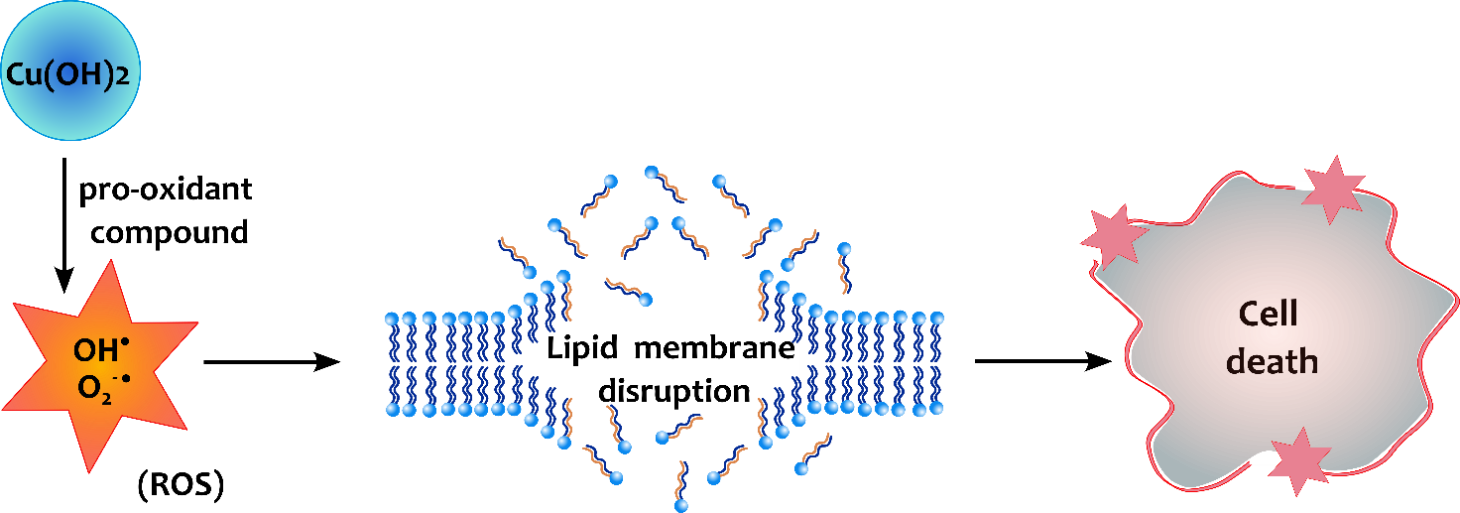
Insoluble copper-based nanoparticles, are emerging as promising agents for the decontamination of fluids and surfaces. In oxidative environments, copper oxide and hydroxide generate reactive oxygen species (ROS), which trigger lipid peroxidation and ultimately compromise the integrity of bacterial membranes. To enhance their effectiveness and identify optimal conditions for their use, a detailed understanding of their lipid degradation mechanisms is essential.
Building on previous experiments demonstrating that Cu(OH)₂ nanoparticles can successfully degrade phospholipid bilayers mimicking the inner E. coli membrane (DOI: 10.1039/d5sm00809c), this internship aims to extend this investigation to lipopolysaccharides (LPS), a key glycolipid found in the membrane and involved in antibiotic defense.
Project Objectives and Scientific Challenges
The objective of the internship is to determine whether the copper-based particles (namely, Cu(OH)2 and CuO) are capable of modifying or even oxidizing these glycolipids. The challenge is to deposit a glycolipid monolayer onto a solid substrate and to study how it behaves when exposed to a solution of copper ions or a suspension of copper particles.
The interdisciplinary nature of this work, bridging the biophysics of biomembranes and the chemistry of nanomaterials, is essential for addressing the complex interactions between metal ions / nanoparticles and an essential membrane component of Gram negative bacteria.
Work program
The student will be actively involved in the following tasks:
- Perform the experimental work on lipopolysaccharide monolayers using the Langmuir trough, and interpret the phase behavior at varying cupric ions concentrations in the aqueous subphase.
- Perform biophysical characterization of the monolayer before and after the adsorption/penetration of the particles, in order to determine its hydration and mass, as well as any chemical changes it has undergone.
Laboratory-based methods will provide essential information, namely:
- Quartz crystal microbalance with dissipation (QCM-D): bilayer hydration and viscoelasticity,
- Surface Plasmon Resonance (SPR): lipid mass loss,
- Attenuated Total Reflectance-Fourier Transform Infrared spectroscopy (ATR-FTIR): nanoparticle–lipid penetration and chemical modifications,
- Atomic Force Microscopy (scanning mode): surface morphology and mapping of intact versus degraded regions.
- Neutron scattering experiments will be formally requested to the Large Scale facilities to explore the internal bilayer composition before and after exposure to the copper salts.
Expected results and impact
The proposed research develops across biophysics, chemistry, and physico-chemistry, an essential feature for addressing fundamental aspects of the mechanisms of action of bactericidal compounds on living cells, and understanding how membrane components modulate susceptibility to antimicrobial agents. This knowledge contributes to a broader framework aimed at elucidating how bacteria adapt their lipidome to mitigate oxidative stress, which is essential for tackling the growing issue of antibiotic resistance, a major threat to human health.
The applicant must submit a detailed curriculum vitae and transcripts (ranking) for the first year of the Master’s degree (M1).
Download
BacterialMembraneDegradation_CopperSalts_final.pdf (PDF, 271.5 KB)
Contact
Samantha MICCIULLA
MODI team (LIPhy, Grenoble)
samantha.micciulla univ-grenoble-alpes.fr (samantha[dot]micciulla[at]univ-grenoble-alpes[dot]fr)
Gwenael CORBEL
IMMM (Le Mans)
gwenael.corbeluniv-lemans.fr (gwenael[dot]corbel[at]univ-lemans[dot]fr)
- Share
- Share on Facebook
- Share on LinkedIn