
- Share
- Share on Facebook
- Share on LinkedIn
Recruitment
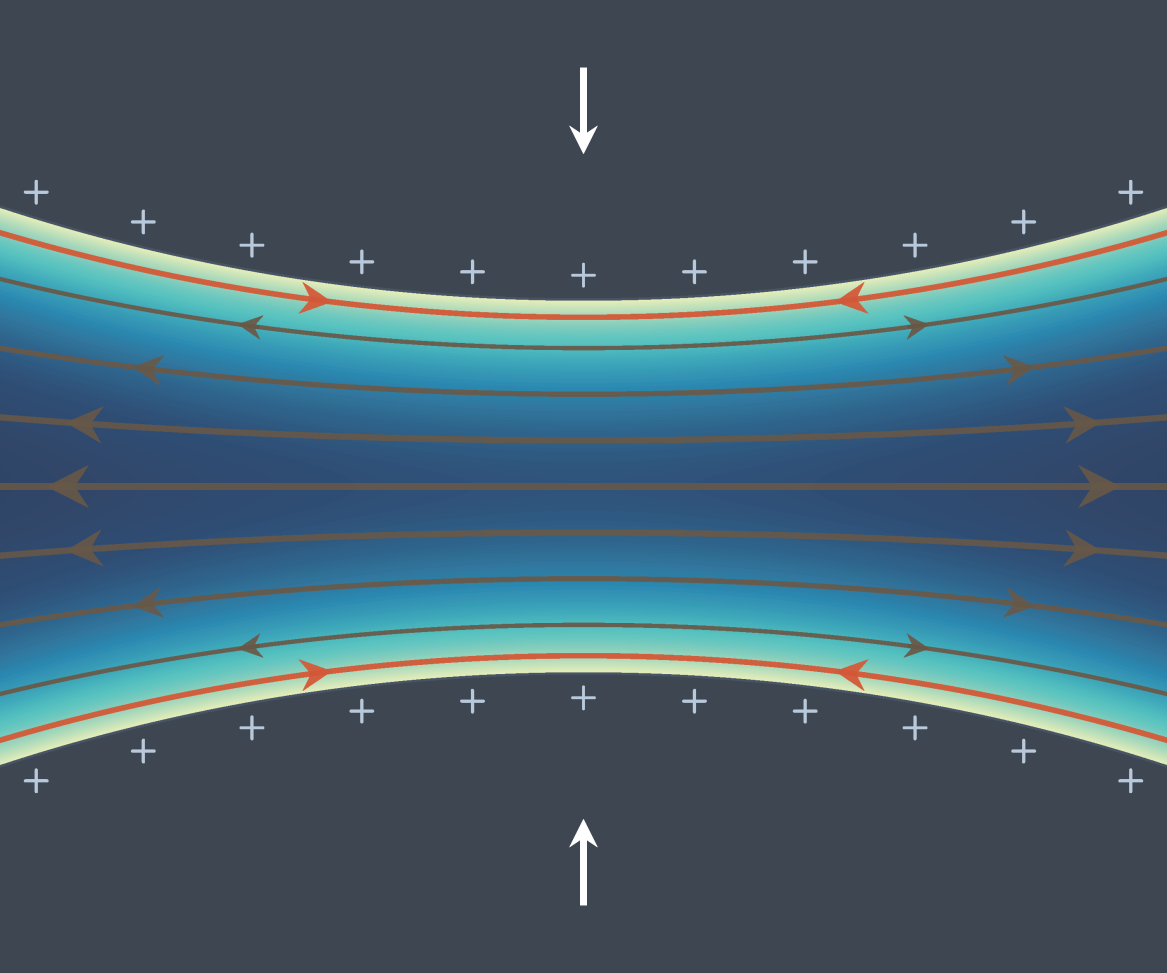
How does a saline solution flow, and how does it conduct electricity when confined?
In bulk, the flow and electrical conduction properties of saline solutions are now well understood. But what happens when the liquid is confined to a space of a few tens of nanometers, or even just a few nanometers? This question lies at the heart of many natural phenomena and emerging technologies: transport across cell membranes, blood filtration, pollution control, osmotic energy recovery, electrochemical storage, and iontronics.
When confinement reaches a few tens of nanometers, interactions with surfaces become critical: hydrodynamic slippage, electrokinetic couplings, and the capacitance of the electric double layer profoundly alter transport properties. At the scale of a few nanometers, the continuous description itself reaches its limits, and molecular structure, electrostatic correlations, and fluctuations become dominant; fluid, ionic, and electronic transport are then found to be closely coupled [1].
Transports in confined saline solutions are typically studied using nanofluidic devices or electrochemical techniques. However, these approaches present a major challenge: simultaneously and precisely controlling both the confinement (without edge effects or pore distribution) and the boundary conditions at the surfaces (charge, slippage) in contact with the liquid. The dynamic Surface Force Apparatus (dSFA) developed in our laboratory offers precisely this capability.
Thanks to this instrument, we recently demonstrated that a saline solution confined between glass surfaces does not behave like a simple viscous liquid: it exhibits hydrodynamic overdamping [2]. We have established that this phenomenon arises from electroosmotic counterflows generated in the vicinity of electrostatically charged insulating surfaces, and have quantitatively described its amplitude and extent as a function of the solution’s properties [3].
When the insulating glass surfaces are replaced by conductive platinum surfaces, we observe, conversely, underdamping compared to a liquid of the same viscosity without electric charges. The interpretation of this phenomenon remains to be established. One thing is clear, however: the electrical nature of the confining surfaces can profoundly alter the flow of the liquid.
The objective of this internship is to understand how the electrical conductivity of confining surfaces controls the flow properties of a nanoconfined saline solution. To this end, the project will utilize semiconducting surfaces, which will allow for the experimental exploration of a situation that lies between insulating and conducting surfaces.
The internship will consist of several complementary stages:
-
fabrication of surfaces by sputtering;
-
characterization of their topography using atomic force microscopy (AFM);
-
conducting dSFA experiments to measure hydrodynamic forces in confined solutions;
-
analysis and modeling of the results to identify the role of surface conductivity.
All necessary experimental techniques are available and mastered in the laboratory. The internship will thus allow the candidate to gain training in a range of cutting-edge experimental techniques at the interface between fluid mechanics, condensed matter physics, and interface physics.
This project is part of a research theme currently being developed at the laboratory and may be continued as a doctoral thesis, funded under the ANR JCJC ElectroMecano project. Continuing the project will, in particular, allow us to take a deeper look with the combination of mechanical and electrical measurements within the dSFA, in order to develop a unified understanding of fluid, ionic, and electronic transport under confinement.
[1] N. Kavokine, R. R. Netz & L. Bocquet, Fluids at the Nanoscale: From Continuum to Subcontinuum Transport, Annual Review of Fluid Mechanics 53:377-410 (2021)
[2] C. Cramail, Forces de surface dynamiques des solutions ioniques confinées : mesures expérimentales et modélisation théorique, PhD Thesis (2024)
[3] C. Cramail, R. Lhermerout, B. Cross & Elisabeth Charlaix, Hydrodynamic forces in the drainage of an electrolyte confined between dielectric surfaces, J. Fluid Mech. (in press)
Download
2027_StageM2_EN.pdf (PDF, 221.65 KB)
Contact
Romain LHERMEROUT
MODI team
romain.lhermerout univ-grenoble-alpes.fr (romain[dot]lhermerout[at]univ-grenoble-alpes[dot]fr)
- Share
- Share on Facebook
- Share on LinkedIn