
- Share
- Share on Facebook
- Share on LinkedIn
Recruitment
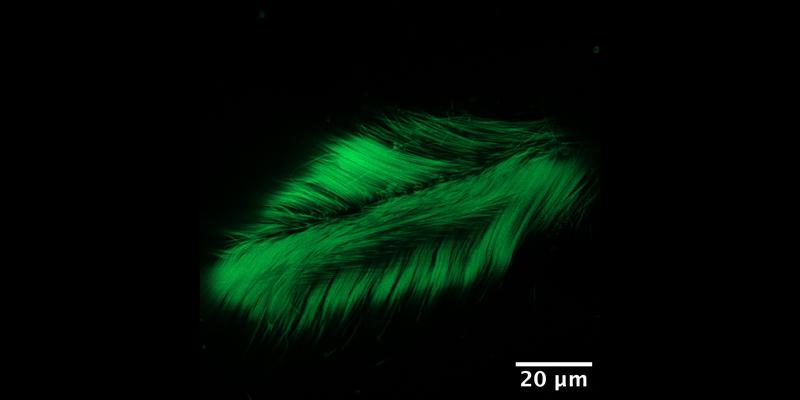
Marine invertebrates go through a biphasic cycle in which a swimming larva turns into an attached and much less motile adult [1]. Many animals go through this type of development, including sea urchins, sea stars, corals, and sea anemones. During this transition, the larva interprets mechanical and chemical cues to trigger this metamorphosis.
For now, there is no clear mechanism linking sensory input to the start of the developmental program.
This project aims to identify a standardized mechanical cue by designing micropatterned substrates and running behavioral experiments. The project will start with the design and characterization of micropatterned substrates included in the millifluidic chip. Behavioral experiments will consist of swimming assays in microfabricated chambers. Swimming statistics will be extracted from the time-lapses with image analysis to identify potential biases introduced by the surface roughness [2].
Based on the results of these studies, the project can be further extended by investigating larval ciliary activity in the vicinity of the micropattern, to propose mechanisms for mechanosensory inputs.
A training background in experimental physics or engineering is welcome. The internship should last at least 4 months, and can be followed by a thesis.
[1] Michael G Hadfield, Eugenio J Carpizo-Ituarte, Kimberly Del Carmen, and Brian T Nedved. Meta- morphic competence, a major adaptive convergence in marine invertebrate larvae. American Zoologist, 41(5):1123–1131, 2001.
[2] Marte Lønnum, Madeline M Schuldt, Johan Hovland, Jose Davila-Velderrain, and Lena Van Giesen. Developmentally timed sensory integration enables efficient larval dispersal. iScience, 29(9), 2026.
Contact
Manon VALET
MC2 team
manon.valet univ-grenoble-alpes.fr (manon[dot]valet[at]univ-grenoble-alpes[dot]fr)
- Share
- Share on Facebook
- Share on LinkedIn