
- Share
- Share on Facebook
- Share on LinkedIn
Seminar
On January 12, 2026
Valentin Leroy (Laboratoire Matière et Systèmes Complexes, Paris)
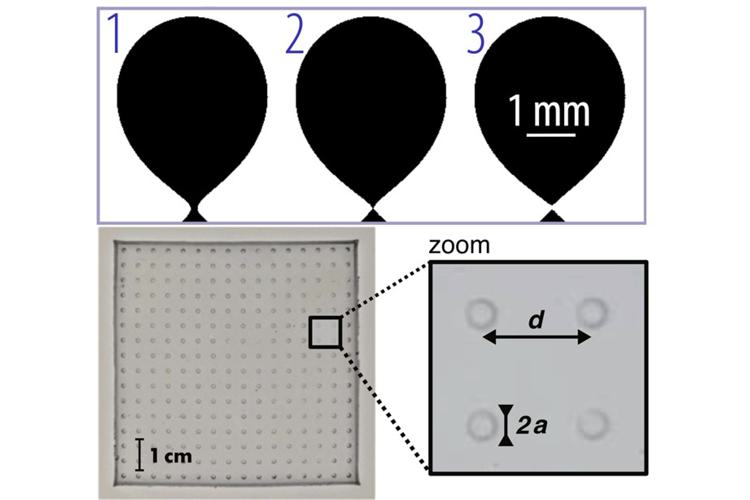
A bubble makes a sound when it detaches. While the frequency of this sound is well understood, there has been no consensus on what causes its amplitude. Although mechanisms based on shape oscillations, initial velocity, neck collapse or Laplace pressure have been suggested, these have not been systematically verified through experimentation. Our experiments, with bubbles released from a nozzle or entrapped by the impact of a drop, show that the initial velocity scenario provides a reasonable prediction of the sound amplitude, over three orders of magnitude. We refined this scenario by describing how the bubble velocity is affected by gas exchange through the closing neck. This ``leaking bubble'' model predicts that the bubble begins to produce sound prior to detachment, as observed experimentally. By feeding image analysis of the neck into the model, we obtained excellent agreement between the experimental and the calculated pressure signals.
Bubbles can also absorb sound. A thin flexible coating consisting of air cavities embedded in a rubber elastomer can achieve acoustic absorption down to the kilo-hertz range. We demonstrate this by characterizing a standard commercial aquarium, identifying its resonances, and designing an optimized bubble screen configuration that effectively reduces reflections in the 3–6 kHz range, approaching the acoustic behavior of an infinite open-water environment. Time-domain analysis confirms that applying this coating significantly reduces tank reflections, offering a practical method for improving the accuracy of underwater acoustic research.
Contact: Benjamin Dollet
Date
11:00
Localisation
LIPhy, salle de conférence
- Share
- Share on Facebook
- Share on LinkedIn