
- Imprimer
- Partager
- Partager sur Facebook
- Partager sur LinkedIn
Séminaire
Le 2 avril 2026
Arthur Hernandez (Leiden University)
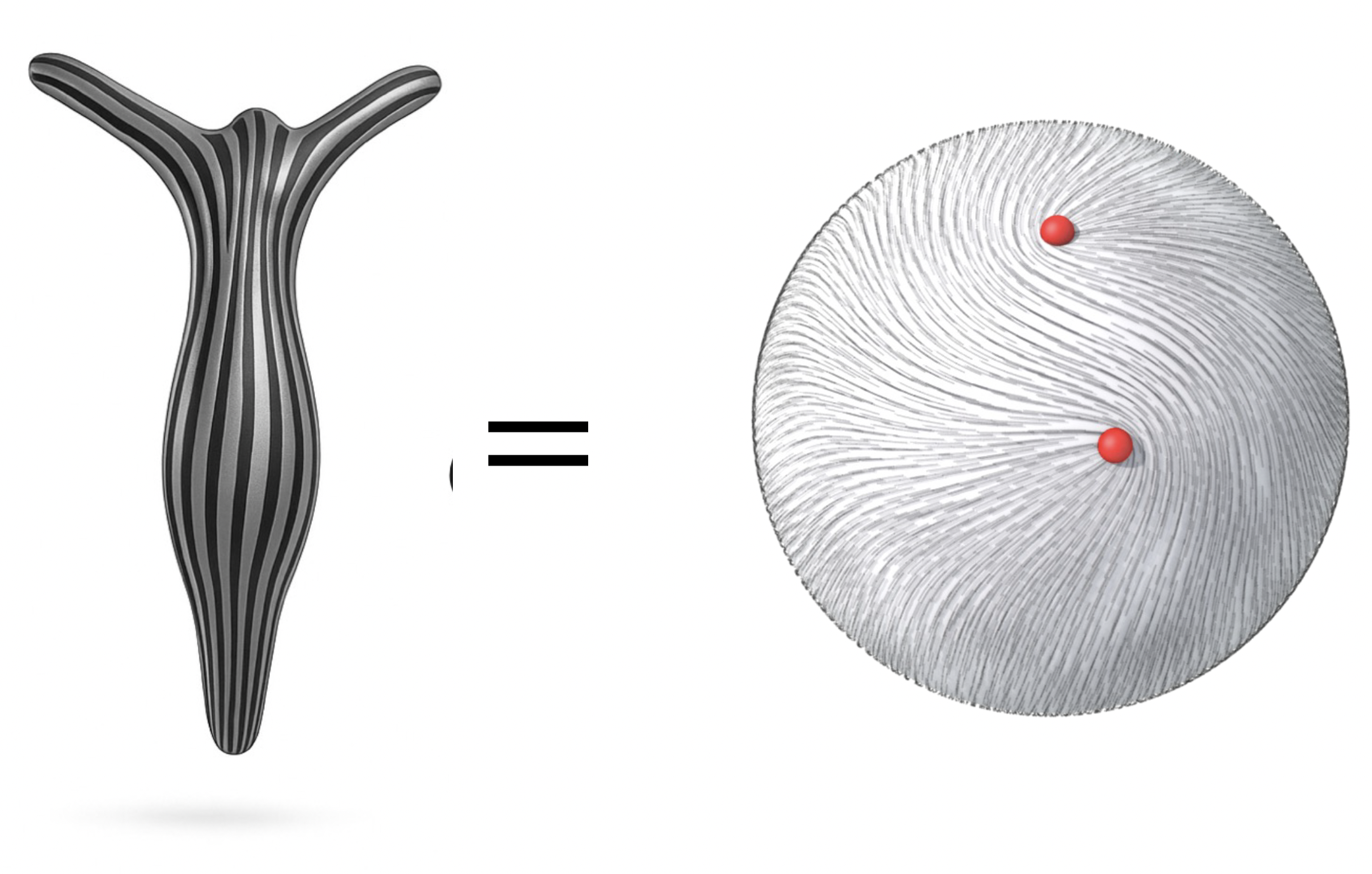
The emergence of a body axis is a fundamental step in the development of multicellular organisms. For example, in simple systems such as Hydra, growing evidence suggests that mechanical forces generated by collective cellular activity play a central role in this process. In this seminar, I will propose a physical mechanism for axis formation based on the coupling between active stresses and tissue elasticity. The interplay between elastic deformations induced by activity-generated stresses, nematicity, and spherical topology results in a global condensation of forces and defects which defines either a bipolar or polar head-foot axis. Compact parametrizations of the active force and flux distributions enable analytical predictions and direct comparison with experimental data on tissue stretching of Hydra. Within this framework, one may calculate relevant observables including areal strain, lateral pressure, and normal displacements during muscular contraction, as well as the detailed structure of topological defect complexes in head and foot regions. Together, these results identify a mechanical route by which active tissues can spontaneously break symmetry at the organismal scale, suggesting a general physical principle underlying body-axis specification during morphogenesis. Time permitting, I will also discuss extensions of this framework towards wrinkling of active nematic sheets where the feedback between nematic defects and spontaneous curvature can engender a diverse morphology of wrinkle patterning.
Contact: Alexander Erlich
Date
11:00
Localisation
LIPhy, salle de conférence
- Imprimer
- Partager
- Partager sur Facebook
- Partager sur LinkedIn