- Imprimer
- Partager
- Partager sur Facebook
- Partager sur LinkedIn
Séminaire
Le 16 mars 2026
Martha Merrow (LMU Munich, Germany)
The circadian clock is a molecular machine that is present in each one of our cells, directing diverse processes in a cell(developmentally)-specific manner. The natural state of the clock is ‘entrainment’, namely through synchronization with zeitgeber signals (such as the light/dark cycle) in the environment. Once moved to constant conditions, a free running rhythm of approximately 24h can be observed, demonstrating the endogenous nature of the clock. One can understand how the clock relates to our lives by noting the timing of the sleep wake cycle: this is determined by the interaction of the biological (circadian) oscillator and the external zeitgeber cycle. Disrupting the clock in humans and mice leads to increased cancers, metabolic disease and decreased cognitive performance, likely through misexpression of key regulators. The circadian clock is an essential aspect of biology and its function can be regarded as a biophysical phenomenon.
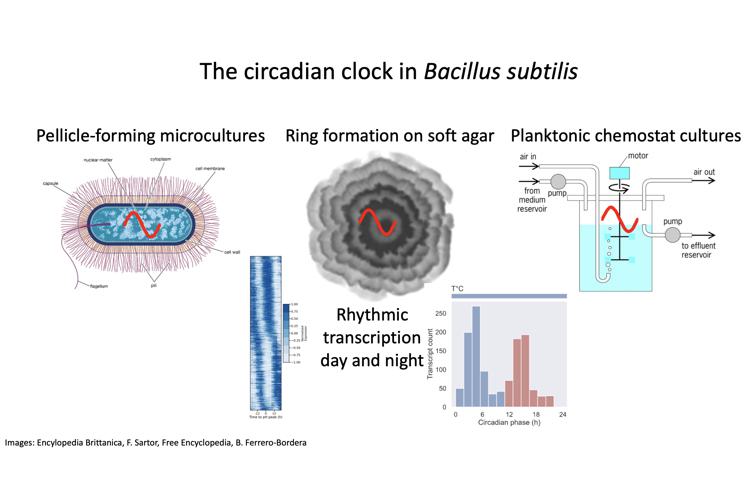
Circadian clocks have been described in all kingdoms of life except for the Eubacteria – until very recently. I will discuss the circadian clock in the model prokaryote, Bacillus subtilis. We observe rhythms in gene expression, in colony morphology on agar, and in metabolism and in planktonic cultures. The circadian transcriptome shows pervasive regulation of gene expression by the biological clock, even more extensively than sigma factors. The clock is thus a major regulatory phenomenon in this bacterium. Our work begs the questions ‘what is the same as clocks in higher organisms?’ and ‘what is different?’.
Contact: Irina Mihalcescu
Date
11:00
Localisation
LIPhy, salle de conférence
- Imprimer
- Partager
- Partager sur Facebook
- Partager sur LinkedIn